Two similar goals, two different challenges
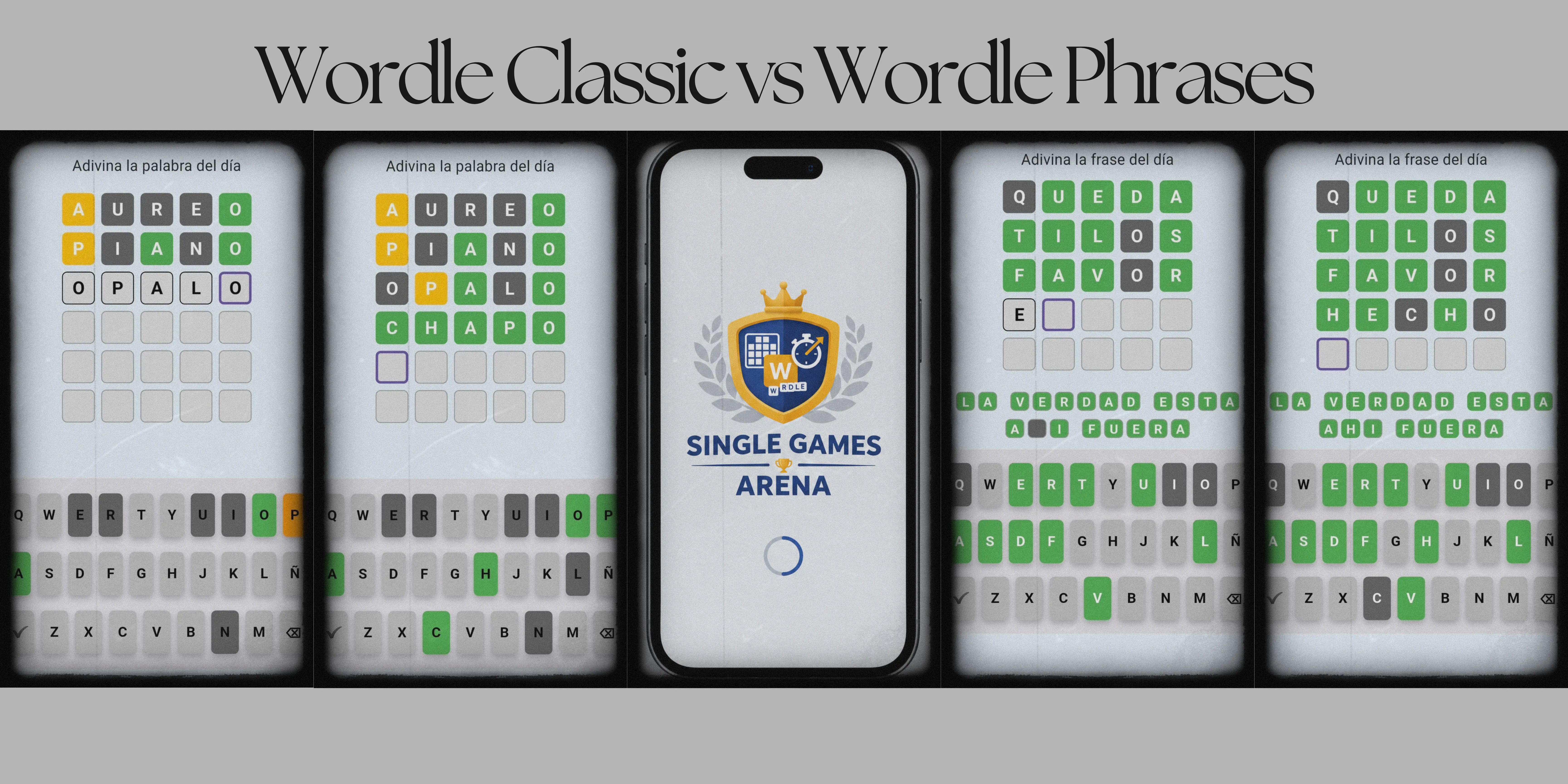
Classic Wordle sets a very specific goal: guess a five-letter word in a maximum of six attempts. Each attempt serves to gather information. Correct letters in the right position, letters that appear in the word but placed elsewhere, and letters that are not part of the solution progressively reduce the possibilities.
In Wordle Phrases, the mechanic starts from a different idea. The goal is also to figure out a word, but this time the word is related to a phrase or quote that serves as context. The information provided by the phrase itself changes the problem completely.
And here lies one of the most interesting differences: in Classic Wordle you have to extract information mainly from the letters; in Wordle Phrases you can also extract it from the meaning.
That means that, although both games share mechanics, the type of reasoning required is different.
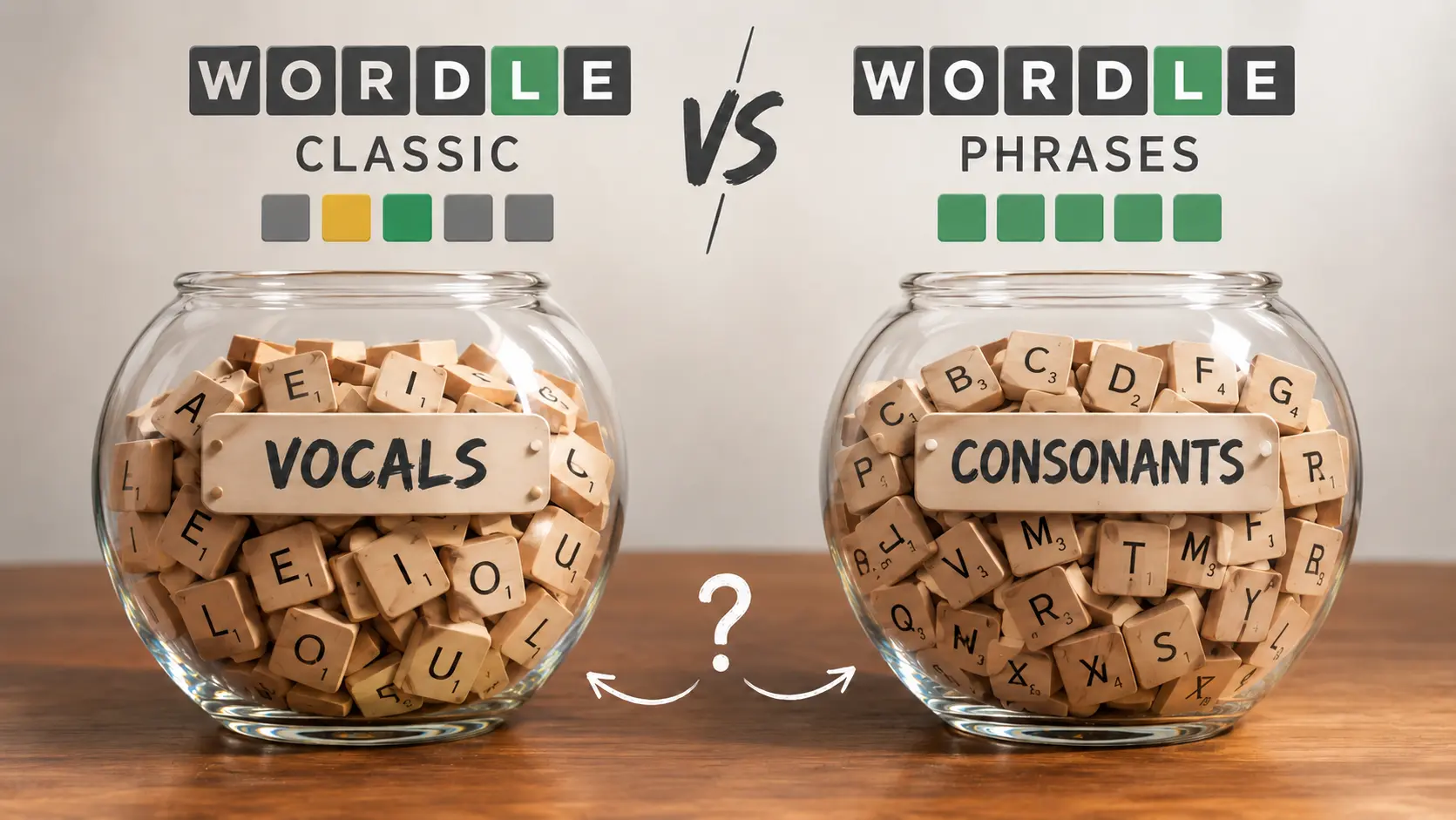
In Classic, vowels are gold
One of the first things worth doing in Classic Wordle is finding out which vowels appear in the word. In a five-letter word, knowing quickly whether it contains an A, E, I, O, or U can dramatically narrow down the number of possibilities.
That is why starting words containing several different vowels are so important. We are not necessarily looking to hit the word on the first attempt. We are looking to get as much information as possible.
Imagine that on the first attempt we manage to discover that the word contains an A and an E, but not an I, O, or U. We have already eliminated a huge number of combinations. If, in addition, one of those vowels appears in a specific position, the possibilities shrink even further.
In Classic Wordle, therefore, the first moves have a strong exploratory component. Sometimes it is worth using a word you know cannot be the answer simply because it contains very useful letters.
In Phrases, consonants take center stage
The situation changes when we know the context of a phrase. If the meaning or structure of the phrase already points us toward certain words, vowels cease to be such a major unknown.
For this reason, in Wordle Phrases it can be especially interesting to use the first attempts to discover consonants. Letters like S, R, N, L, T, D, or M can help quickly identify the structure of a word that we already have more or less pinpointed thanks to the context.
It is a subtle difference, but an important one. In Classic we might think: “What vowels does this word have?”. In Phrases we might think: “I think I know where this word is going; now I need to confirm its structure”.
Naturally, this does not mean vowels should be ignored in Phrases. It means that the value of information shifts depending on the game.
Context plays too
This is probably the most significant strategic difference between both modes.
In Classic Wordle, a word can be a candidate because it fits perfectly with the discovered letters. In Wordle Phrases, it also has to fit the meaning of the sentence.
This allows for a strategy that does not exist in the same way in Classic: mentally generating several possible answers based on context and then using the letters to rule out incorrect ones.
For example, if the context suggests a specific action, we can think of several verbs that could fit. We do not need to test all of them. We can look for the consonants that set them apart and use an attempt to gain that information.
In a way, Wordle Phrases combines two types of play: a small part of semantic guessing and another part of letter logic.
Is Wordle Phrases easier?
In general terms, it can be reasonably easier to reach the solution when context provides a clear enough clue. But that does not mean it is simply an easy version of Classic Wordle.
The difficulty shifts.
In Classic, much of the challenge lies in navigating a vast set of potential words using only letter feedback. In Phrases, context can narrow that set down significantly, but then you must interpret the clue correctly and find the word that best fits.
That is why the way a good game is evaluated also changes. Solving a Wordle Phrases in five attempts does not mean quite the same thing as needing five attempts in Classic.
Stats also tell the story differently
Both modes share a fundamental rule: consistency matters a lot. Getting a great game once in a while is not worth much if we accumulate many failures afterward. Maintaining good consistency is a key part of any daily game.
However, the metrics we should care about are not strictly identical.
In Classic Wordle, the win percentage carries special weight. With six attempts and no extra semantic clue, maintaining a streak of solved games proves that you are managing possibilities well and avoiding running out of guesses.
In this mode, therefore, a conservative strategy makes a lot of sense. It is not always worth risking a guess when you can still gather information with one more move.
In Wordle Phrases, on the other hand, solving quickly becomes more important. If context allows us to approach the solution reasonably well, using four or five attempts when we could have found it in two or three means missing an opportunity to score higher.
That is why here the number of attempts can be a more interesting indicator of skill level. It is not just about getting it right, but about taking advantage of the available information to do so as quickly as possible.
Points and consistency: winning a game isn't everything
Points also introduce a different competitive dimension. A perfect game can be very satisfying, but after playing many rounds, something else starts to matter: consistency.
This is particularly interesting when comparing statistics between both modes. In Classic, maintaining a high win percentage might be a primary objective. In Phrases, besides maintaining consistency, the goal is to progressively lower the average number of attempts.
In fact, two players can have a very similar number of solved games and yet yield very different overall results. One might consistently solve near the attempt limit, while the other finds answers much faster.
Statistics thus begin to tell more than simple wins: they reflect the strategy we use to play.
Which Wordle is more strategic?
It is tough to say that one is more strategic than the other. What changes is the type of strategy.
Classic Wordle especially rewards the ability to gather information with every attempt, knowing letter frequencies, leveraging vowels, and carefully managing remaining possibilities.
Wordle Phrases adds to all that the ability to interpret context. You must know when to trust the semantic clue, when to use a word to confirm a hypothesis, and when it is worth looking for consonants that distinguish between multiple viable answers.
In Classic, you play heavily against the uncertainty of letters. In Phrases, you play against the uncertainty of interpretation.
Two ways to play the same game
Perhaps that is the best way to understand the difference between both modes. Classic Wordle and Wordle Phrases share instantly recognizable mechanics, but they require slightly different skill sets.
If you play Classic, think about information: what letters you can reveal, what options you can rule out, and how to make the most of every guess.
If you play Phrases, think also about context: what words could fit the sentence, which consonants can confirm your hypothesis, and how to turn a semantic clue into a concrete solution.
And if you want to compete, do not look solely at how many games you have won. In Classic, keep a close eye on your win rate and consistency. In Phrases, aim to reduce the number of guesses needed to reach the solution.
Ultimately, that is where the charm lies: two seemingly identical games can reward different ways of thinking. And perhaps that is one of the reasons why switching between both is so entertaining.
At Single Games Arena you can play both Classic Wordle and Wordle Phrases, improve your statistics, and compare your results. Because solving the word of the day is one thing… and learning to solve it better every time is another story entirely.