
1. The Impossible Shapes Club: Geometry Out of the Norm
If you are asked to draw a flag, you will instinctively trace a rectangle. However, in the world of vexillology, rules are meant to be broken. There are three nations that defy geometric standardization:
- Nepal: It is the only national flag in the world that is not quadrilateral. Its design is based on two overlapping pennons (triangles). The upper one contains a moon and the lower one a sun, symbolizing the hope that the nation will last as long as these celestial bodies.
- Switzerland and Vatican City: These are the only countries with officially square flags (1:1). While most international flags follow proportions like 2:3 or 3:5, these two maintain perfect symmetry. Interestingly, Switzerland uses a rectangular version exclusively for its merchant navy and at the Olympic Games to blend in with the rest.
2. The App Dilemma: How to Distinguish Ireland from Ivory Coast
In the heat of a timed match in our App, it's very easy to make a mistake that costs you a 30-second penalty. The confusion between Ireland and Ivory Coast is the "Achilles' heel" of many players. Both use orange, white, and green, but their meaning and order are reversed:
The key is to always look at the hoist side (the left):
- Ireland: Green is on the left. It represents Catholics (green), Protestants (orange), and the peace between them (white).
- Ivory Coast: Orange is on the left. Orange symbolizes the land of the savannahs in the north, white represents peace, and green represents the hope of the forests in the south.
3. The Forbidden Color: The Mystery of Purple
Have you noticed that there is hardly any purple in the more than 150 flags of our long version? It's not a matter of aesthetic taste, but of historical economics. Until 1856, purple dye was obtained from a small sea snail called murex. Thousands of snails were needed to dye just one gram of fabric, which made purple more expensive than gold.
Since flags were manufactured in large quantities, no country could afford that cost. Therefore, only flags created or modified very recently, such as that of Dominica (featuring the Sisserou parrot) or Nicaragua (in the rainbow of its coat of arms), dare to show this color.
4. The Union Jack: A Historical Puzzle of Three Kingdoms
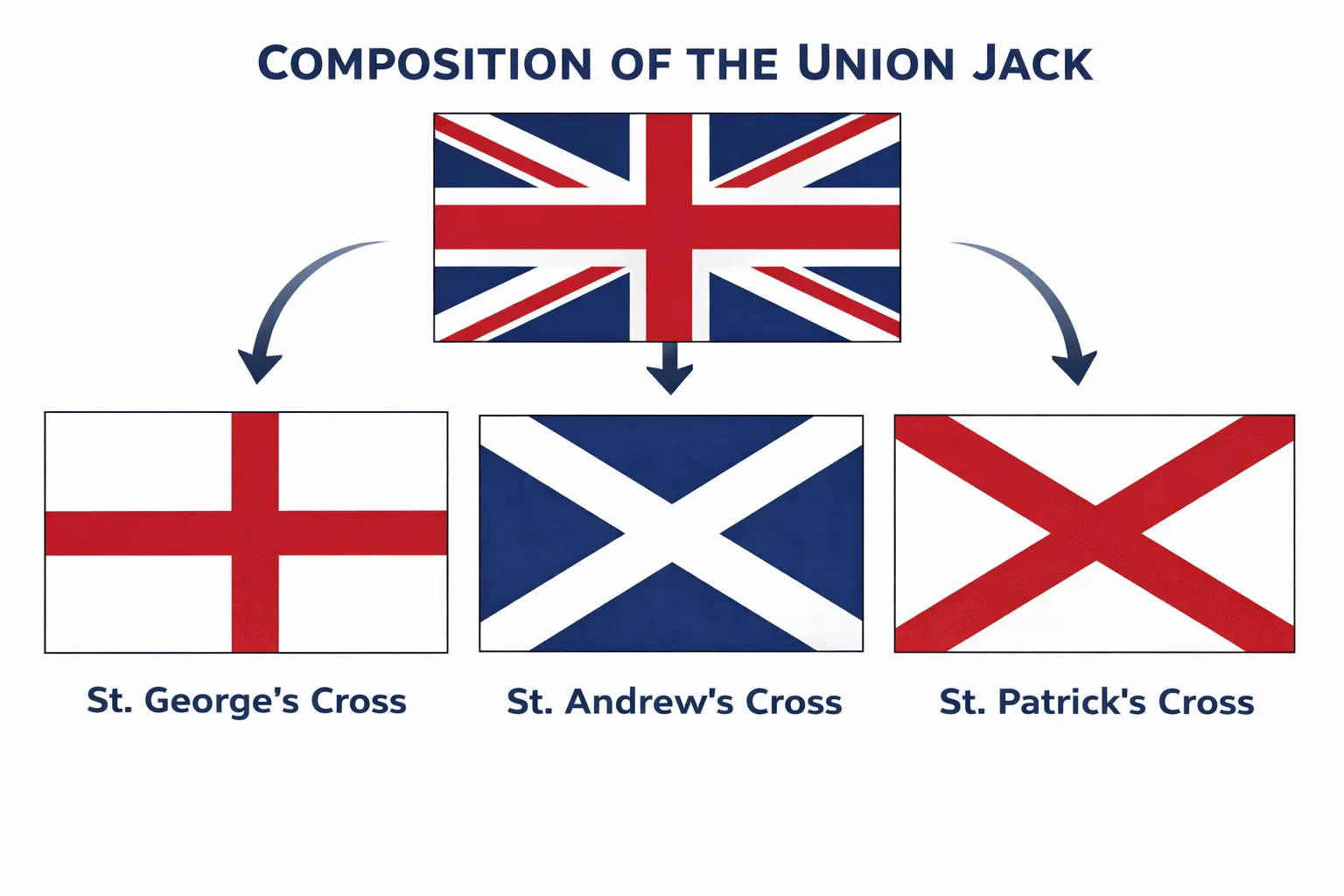
The flag of the United Kingdom is not a single design, but a "collage" of the flags of its patron saints. It is essential to understand this to distinguish it from flags of British heritage like those of Australia or New Zealand:
- England: The vertical and horizontal red cross of Saint George.
- Scotland: The white saltire on a blue background of Saint Andrew.
- Northern Ireland: The red saltire on a white background of Saint Patrick.
Why doesn't Wales appear? Because when the first version of the Union Jack was created in 1606, Wales was already considered part of the Kingdom of England. That's why we don't see its famous red dragon in the puzzle!
5. The Philippine War Code
The Philippines possesses one of the most curious vexillological traditions on the planet. Its flag is a direct indicator of the nation's socio-political state. Under normal conditions of peace, the flag is flown with the blue stripe on top (symbolizing justice and truth). However, if the country officially enters war, the flag is flipped so that the red stripe is on top, representing patriotism and valor on the battlefield.
6. The Nomadic Symbolism of Kazakhstan and Kyrgyzstan
These two Central Asian nations are often a challenge in Single Games Arena due to their designs filled with golden solar elements. Understanding their nomadic culture helps to distinguish them:
- Kazakhstan: Its sky-blue background represents the infinite sky under which the Turkic peoples lived. The sun has 32 rays and, just below, a steppe eagle flies with pride.
- Kyrgyzstan: Its flag is intense red. The sun has exactly 40 rays, one for each of the 40 tribes that the hero Manas united to found the nation. The central circular symbol is a tunduk, the wooden piece that crowns a yurt (traditional tent). It's what you would see if you looked up from inside one of these traditional dwellings.
7. The Dynamism of the USA: From 13 to 50 Stars
Unlike most flags that remain static for centuries, the United States flag is one of the most changing in history. 27 different versions have been approved since 1777.
The law dictates that a star must be added to the design every time a new state joins the Union, always on the July 4th following its admission. The current 50-star version is the most durable; it was adopted on July 4, 1960, after Hawaii became the 50th state in August 1959. If Puerto Rico or Washington D.C. were ever admitted, we would see the birth of the 51st star!
8. The Guardians of Time: Which is the Oldest Flag?
Determining which is the oldest flag is complicated due to variations in designs, but there are three main candidates:
- Denmark (Dannebrog): It holds the Guinness World Record as the oldest national flag in continuous use. Legend says it fell from the sky in 1219, although it is officially documented since the 14th century.
- Scotland: Its Saint Andrew's cross (Saltire) is believed to have been used for the first time in the year 832 AD during a battle against the Angles, which would make it one of the oldest, although technically it is a national flag "within" another.
- Netherlands: Its current tricolor design (red, white, and blue) dates back to 1572. It was the first great tricolor flag in history and directly inspired the flag of Russia and, subsequently, that of France.
9. The Language of Colors: Pan-Africa and Pan-Arabia
If you feel lost in the 150-flag mode, grouping by regions will save your life. Many flags share colors for reasons of political solidarity and common history:
- Pan-African Colors: Red, yellow, and green. These colors were inspired by the flag of Ethiopia, the only African nation that managed to resist large-scale European colonization. Countries like Ghana, Senegal, or Cameroon adopted them after their independence.
- Pan-Arab Colors: Red, white, black, and green. They are based on the flag of the Arab Revolt of 1916. Each color represents a different historical dynasty: the Umayyads (white), the Abbasids (black), the Fatimids (green), and the Hashemites (red).
10. Paraguay: The Secret of the Two Sides
Paraguay holds a unique distinction at the United Nations: it is the only country whose flag has a different obverse and reverse. It's not that the design is "transparent," but that the two sides of the fabric are different by law.
- On the obverse (front), we find the Coat of Arms of Paraguay: a yellow star surrounded by a palm and an olive branch.
- On the reverse (back), the Treasury Seal appears: a lion sitting in front of a pike topped by the Phrygian cap (universal symbol of liberty) with the inscription "Paz y Justicia" (Peace and Justice).