
There is a moment in the life of any Minesweeper player when everything changes.
At first, you click without much strategy. Sometimes you survive, sometimes you don't. Then you start to understand the numbers, place some flags, and feel like you're improving. But sooner or later you reach a frustrating point: you lose games that seemed under control and decisions appear that seem like pure chance.
The difference between that point and mastering the game isn't in speed or luck. It's in how you interpret the board's information.
The Key Shift: Stop Reacting and Start Deducing
One of the most common mistakes is playing reactively. You see a number, look around, and click where you think you're most likely to be right.
Players who truly improve do exactly the opposite: they build a global vision. Each number is not analyzed in isolation, but as part of a connected system.
Minesweeper is not solved cell by cell. It is solved by understanding how each piece of information limits the possibilities of the rest.
Reading the Board Like a Logical Map
Every number is a constraint. It doesn't just indicate how many mines are around it, but also how many are NOT there.
When you start to cross-reference information between several numbers, the board stops being ambiguous. What seemed uncertain begins to become deterministic.
This shift doesn't happen all at once. It's progressive. But as soon as you internalize it, the way you play changes completely.
The Role of Patterns
With practice, you begin to recognize configurations you've seen before. Not as a list of memorized rules, but as structures that your brain identifies automatically.
These patterns are simply recurring combinations of information. The important thing is not to memorize them, but to understand why they work.
When you understand the logic behind them, you can adapt them to new situations effortlessly.
1. The 1-1 Pattern
When you have two "1s" in a row facing a wall of closed cells on an edge.
? ? ?
The Logic: The first "1" tells us there is a mine in one of its two available cells. Since the second "1" shares those same two cells, its mine must be there. Therefore, any other cell touching only the second "1" is SAFE.
2. The 1-2-1 Pattern
It is one of the most satisfying ones to find. It usually appears on flat walls.
? ? ?
The Logic: To satisfy the central "2" without overloading the "1s" on the sides, the mines must be at the ends. The cells below the "1s" are MINES and the cell below the "2" is SAFE.
3. The 1-2-2-1 Pattern
Similar to the previous one, but with two twos in the center.
? ? ? ?
The Logic: Here the solution is the reverse. The mines are located right under the twos. The cells under the "1s" are SAFE, while the cells under the "2s" are MINES.
4. The 1 in the Corner
The 1 in the corner is a very common quick-win.
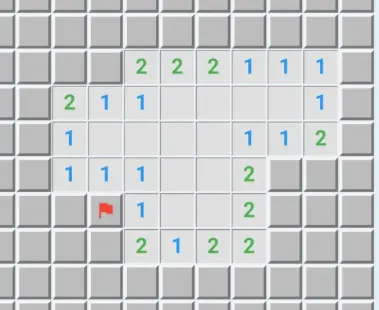
The 1 in the corner is one of the most common patterns and allows for quickly locating a mine. The corner cell touching the "1" is a MINE, which allows deducing that the other cells touching the "1s" are SAFE.
5. The 1 in the Corner with a 2 Below
The 1 and the 2 below in the corner is similar to the previous one.
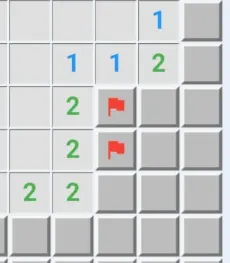
The 1 in the corner complemented by a 2 below allows for quickly locating 2 mines. The corner cell touching the "1" is a MINE, the same as the one immediately below it.
6. Freeing the 3
Freeing a high-value cell is always very satisfying.
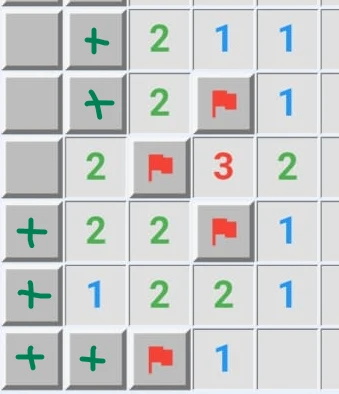
While not exactly a pattern, freeing a cell like the 3 allows us to identify several cells in the surrounding area as SAFE. It is a great example of chained logic.
Reducing Luck to a Minimum
One of the biggest frustrations in Minesweeper is facing decisions where there seems to be insufficient information.
Although situations where risk is inevitable exist, most of the time they are reached too soon by not having exploited all the available information.
An advanced player delays that moment as long as possible. They first resolve all safe moves and only take a risk when there is no alternative.
Practical Example of Probability
Imagine you have two blocked zones:
- Zone A: A 50% probability of dying (1 in 2).
- Zone B: An isolated cell on a large board where 10 mines and 100 hidden cells remain (10% probability of dying).
Many players obsess over solving Zone A. The professional will open a cell in Zone B. Although it seems like "guessing," statistically it has a 90% success rate, and the new information could unlock Zone A without having to risk anything there.
The Habit That Makes the Difference
There is a simple practice that improves performance more than any other: constantly checking the entire board.
Every cell you open can unlock information in another zone. If you stay focused on a single area, it's easy to miss obvious moves elsewhere.
This habit reduces errors, avoids bottlenecks, and increases consistency.
Thinking in Terms of Certainty
The difference between average and advanced players is not just technical, but conceptual.
While some work with probabilities, others look for certainties. They don't click until the information is sufficient to guarantee the result.
This approach reduces errors and makes every decision make sense.
Speed Comes Later
Improving times is a consequence, not an initial goal.
When you start seeing the board clearly, decisions become automatic. You don't need to think faster, you simply need to think better.
Consistency: The True Indicator of Level
Mastering Minesweeper doesn't mean winning an isolated game. It means solving boards consistently, making fewer and fewer mistakes, and depending less on luck.
When you reach that point, the game stops being unpredictable and becomes a logical exercise where you have control most of the time.