How a family Wordle competition changed the way we play (and connect)
I have always liked Wordle. Like many people, I was caught by that simple yet addictive mix of logic, intuition, and vocabulary. It is not a game that demands too much of your time, but just enough for each game to have its own little moment of tension. And that, precisely, is what makes it special.
Before all this started, I already had some experience playing. I wasn't an expert, but I could hold my own. At home, moreover, Wordle had become a small daily tradition. It was quite common that, at some point during the day, someone would ask: "Have you done the Wordle yet?" And from there came the exchange: how many attempts it took you to solve it, if it had been difficult, if the word was strange... those kinds of short but curiously pleasant conversations.
It wasn't a competition as such. Rather, a shared ritual.
The turning point: the family competition
Everything changed when my sister-in-law came up with a rather simple but brilliant idea: create a Wordle competition in Single Games Arena and invite the whole family.
What initially seemed like a simple experiment soon became something much more interesting.
Because playing alone is fine. Commenting on results is too. But competing, even in a friendly way, introduces a completely different dimension.
Suddenly, it was no longer just about solving the word of the day. Now there was a ranking, an evolution, a story behind each attempt. You could see how you were doing compared to the others, who was on a winning streak, who had missed a day... and that totally changed the experience.
From individual game to shared experience
What struck me most was how something as simple as structuring the competition made everything more tangible. Before, conversations were ephemeral: "me in four," "me in five." Now, those results accumulated and had consequences.
There were positions. There were point differences. There were goals.
And most importantly: there was continuity.
This made each game matter a little more. Not in the sense of generating pressure, but in the sense of giving it context. It was no longer just "I played well today," but "this helps me maintain or improve my position."
The real key: consistency
If there is one thing I have learned from this experience, it is that in a Wordle competition, consistency is much more important than occasional talent.
You can be very good at solving words in a few attempts, but if you don't play every day, you'll have a very hard time winning. In fact, I would say it's almost impossible.
And this is something that becomes very clear as the weeks go by. There are people who are brilliant at solving in three or four attempts but fail in continuity. And others who, without especially standing out in each game, are always there, adding up day after day.
In the end, the system rewards discipline.
And that, curiously, makes the game integrate into your daily routine very naturally.
Creating habits: the silent secret
To maintain that consistency, everyone finds their own moments. In my case, for example, I often play in the morning with my coffee. It's a quiet, almost automatic moment.
Others do it in the bathroom. Some on the bus or the subway. It doesn't matter when; the important thing is that that moment exists.
Because when you turn Wordle into a habit, it stops being something you "have to remember to do" and becomes something that is simply part of your day.
And that makes all the difference in a long competition.
Beyond the general ranking: internal "rivalries"
Although the global ranking is important, the most fun part is often not in who is first, but in the small battles generated within the table.
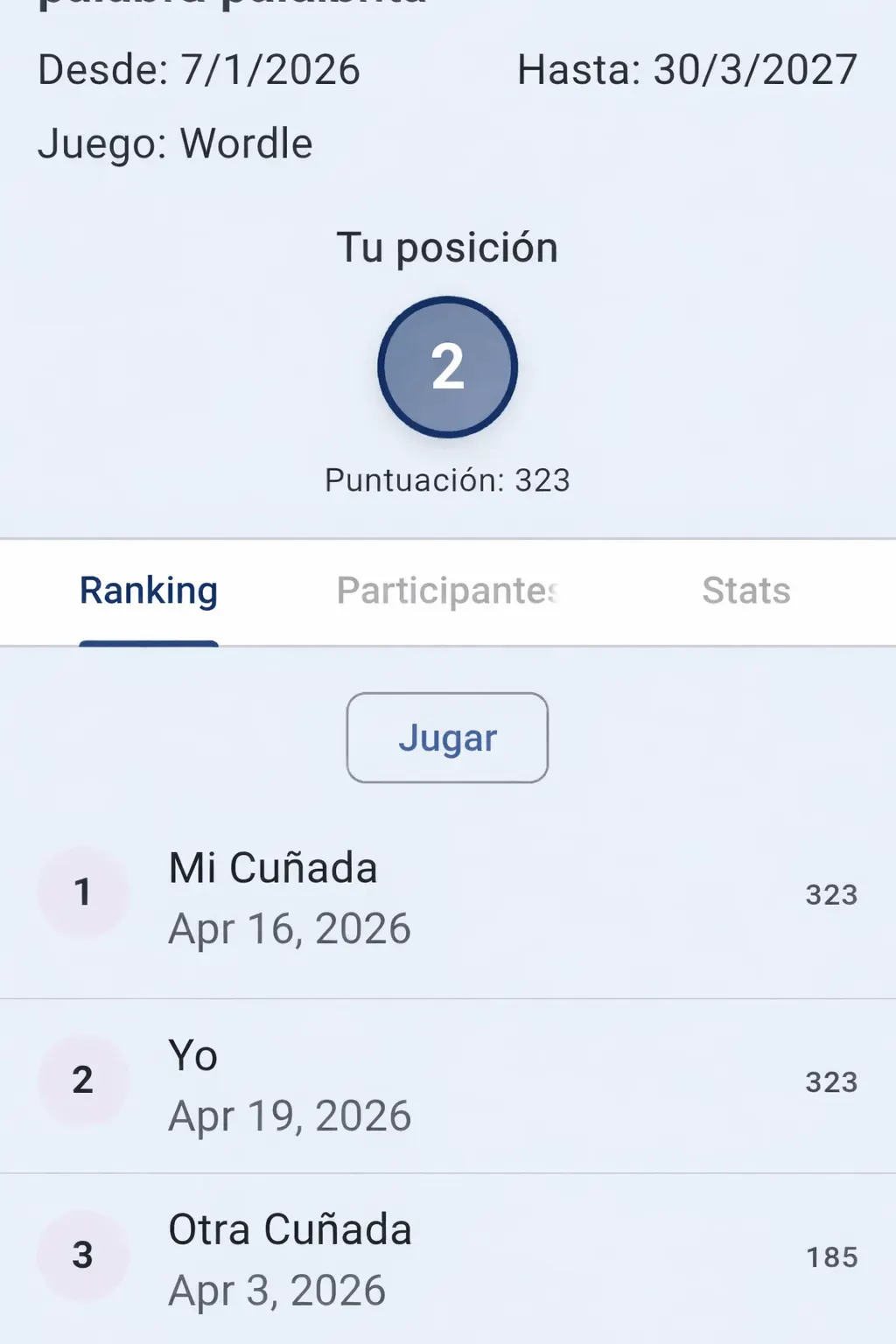
For example, in our family, there have been some quite funny moments with very specific positions. My niece and her mother, for instance, spent quite a bit of time fighting for third place. Each day was a little story: who had overtaken whom, by how much, if it was maintained or not...
On another level, we also had a curious group formed by my wife, my nephew, and a friend, constantly alternating between fifth, sixth, and seventh position. One day one goes up, the next they go down, then another goes up again... and so on continuously.
These "rivalries" make the competition much more alive. You don't need to be fighting for first place to be involved. There is always something at stake.
A major mistake: the duration of the competition
If there is something I would change without hesitation, it is the duration we set for the competition.
We decided to make it a full year long.
At the time, it seemed like a good idea. We thought that way there would be enough time for everyone to participate, for there to be room for improvement, etc.
But over time I have realized it was a mistake.
One year is too long.
The problem isn't that people lose interest, but that the reward is too far away. Motivation needs shorter cycles, closer goals.
When you know there is a lot of time left until the end, it's easy to relax, let days go by, and think that "you'll catch up later."
In contrast, if the competition lasts between two and three months, each day counts much more. The sense of progress is more immediate and the goal is close enough to maintain interest.
Looking back now in retrospect, that would be the main change I would make: shorten the duration.
What I miss (and what could improve)
Although the overall experience has been very positive, there are some features that I believe would greatly improve these types of competitions.
For example, a reminder system would be very useful. Sometimes you simply forget to play, not for lack of wanting to, but out of absent-mindedness. A small notification could make the difference.
It would also be interesting to receive notifications when someone overtakes you in the ranking. That would add an extra point of excitement and keep you more connected with the group's progress.
And then there's the data. Personally, I would like to see more detailed statistics: number of games played, average score, evolution over time... that kind of information always adds value, especially if you like analyzing your own performance.
I understand these are things that may arrive over time, and I sincerely believe they would be a great addition.
Much more than a word game
If I have to summarize the experience in one idea, I would say that the most valuable thing is not the competition itself, but what it generates around it.
With just two or three minutes a day, we have created a small shared space. A constant topic of conversation. Something that connects us.
It allows us to joke, tease each other, comment on plays, surprise each other with difficult words... in short, interact in a light but continuous way.
And that, in everyday life, has a lot of value.
Because you don't always need something big to keep in touch. Sometimes something small, repeated over time, is enough.
Final reflection
I started playing Wordle as individual entertainment. Something fast, almost anecdotal.
But thanks to this family competition, it has become something much richer. More social, more dynamic, more meaningful.
I've learned that consistency matters more than occasional talent, that small habits build great results, and that competitions, well-planned, can be a perfect excuse to connect with others.
If you're thinking about organizing something similar, my recommendation is clear: do it.
But do it with a reasonable duration, try to encourage consistency, and above all, enjoy the process.
Because in the end, beyond who wins, the really interesting part is everything that happens between game and game.
Frequently Asked Questions about Wordle competitions
What is a Wordle competition and how does it work?
A Wordle competition is a format where several players compete by solving the daily word. Each attempt adds points, and a ranking is created based on performance and consistency over time.
What is more important in a Wordle competition: skill or consistency?
While the skill to solve words in fewer attempts is important, consistency is key. Playing every day allows you to accumulate points and maintain a good position in the ranking.
What is the ideal duration for a Wordle competition?
A duration of between 2 and 3 months is usually ideal. It keeps motivation high, shows short-term progress, and prevents the competition from becoming too long or losing interest.