
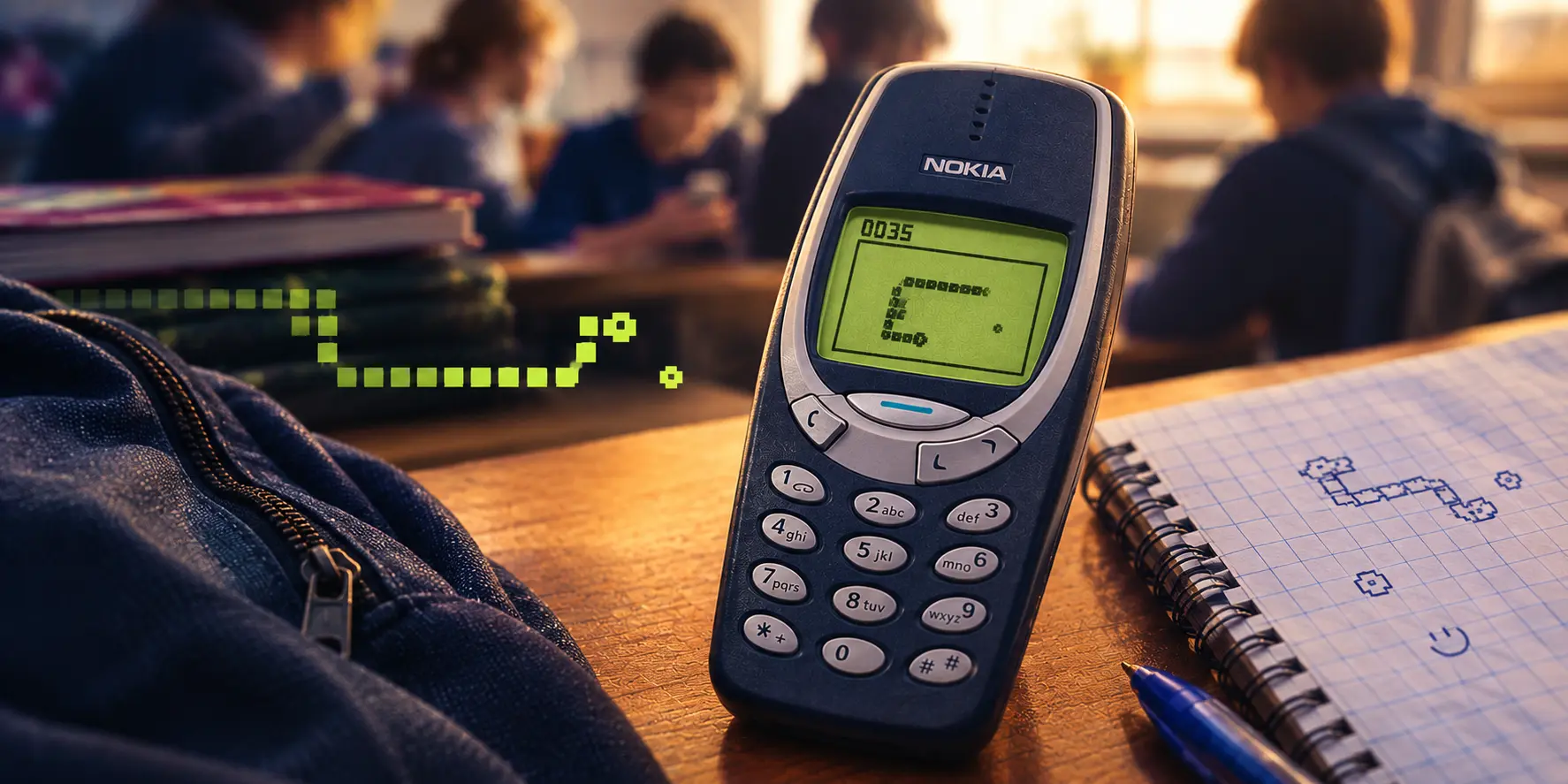
The Snake Game: How It Became a Nokia 3310 Icon
There was a time when owning a mobile phone didn't mean having a camera, Internet access, social media, apps, 3D video games, or a display with hundreds of pixels per inch.
It basically meant being able to make calls and send text messages.
And yet, those phones had something that might seem surprising today: they managed to introduce millions of people to video games for the very first time. It wasn't a handheld console, nor a computer, and there was no need to buy a cartridge or download an app. The game was already inside the phone.
And among all those little games, one ended up becoming a true icon: Snake, the Snake game.
Although we now almost automatically associate it with the Nokia 3310, the story began a few years earlier. And it is precisely that story which explains why such a simple game managed to become part of the pop culture of an entire generation.
Snake Was Not Born on the Nokia 3310
Let's start by dispelling one of the most widespread misconceptions: the Nokia 3310 was not the first phone with Snake.
The version of Snake popularized by Nokia originally appeared in 1997, factory-installed on the Nokia 6110. Its creator was Taneli Armanto, a Finnish engineer who worked on mobile phone software development at Nokia.
Nor was Armanto the one who invented the concept of the Snake. The idea of controlling a growing line that must avoid crashing into itself is much older. One of its most famous predecessors is Blockade, an arcade game by Gremlin released in 1976, which was followed by numerous versions and variants for different systems over the subsequent decades.
What Nokia did was something different: it took an existing idea and brought it to a device that millions of people carried with them every single day.
That was the real revolution.
A Video Game Inside a Phone
Today, we are used to a phone also being a portable console. We can install games with graphics that decades ago would have seemed like science fiction.
In 1997, the situation was completely different. The Nokia 6110 had a small monochrome display of approximately 84 x 48 pixels, and controls were mapped to the phone's numeric keypad. There were no joysticks, touchscreens, or virtual controls. A few keys were more than enough.
Precisely those limitations helped define Snake.
There was no need for a story, a tutorial, or dozens of buttons. The mechanics were understood almost instantly: move the Snake, eat the food, grow, and avoid crashing.
That was it.
And that simplicity turned out to be extraordinarily important. A player could start a game while waiting for the bus, during a break, in a doctor's waiting room, or simply whenever they had a few free minutes. The phone was already in their pocket, and the game was already inside it.
The Secret Was That You Didn't Have to Buy Anything
This is probably one of the most important reasons for understanding Snake's impact.
Before app stores existed, getting a video game on a mobile phone was nothing like installing an app today. Snake was pre-installed. You didn't have to search for it, pay for it, download it, or sign up.
It was simply there.
That made Snake very different from many video games of its era. Its potential audience was not made up of people who had set out to buy a video game, but people who had bought a phone.
The difference seems small, but culturally it was massive.
Suddenly, someone who had never owned a console could discover that the device they used for calling and texting could also be used for gaming. In a way, Snake was one of the first truly massive video games of the mobile era.
Taneli Armanto explains that, by being distributed pre-installed on a huge number of Nokia phones, the game became—by sheer distribution alone—one of the most widely available video games in history.
And Then Came the Nokia 3310
Three years after the release of the Nokia 6110, the phone that would become the ultimate symbol of this story arrived.
The Nokia 3310 was introduced in the year 2000. It was a relatively simple, durable phone with a battery that seemed to last forever by today's standards, and of course, it included games.
Among them was Snake II, an evolution of the original version that introduced new features, such as different mazes and bonus items.
The 3310 also enjoyed extraordinary popularity. Nokia reported in 2003 that it had surpassed 100 million units sold, with final figures hovering around 126 million.
That means the game wasn't just on a popular phone. It was on one of the most popular phones of its time.
And that is where Snake and the 3310 became permanently linked in collective memory.
The First Video Game for Many People
Probably the most interesting aspect of Snake's history isn't its technology, but its audience.
For decades, video games had been associated primarily with arcades, computers, and consoles. That meant playing required going to an arcade, owning a proper computer, or buying a console.
Snake broke down a major part of that barrier.
A child could play. A teenager could play. An adult who had never bought a console could play. Even someone who didn't consider themselves a gamer could end up trying to beat a friend's high score.
And that matters because Snake didn't require you to identify as a gamer. It was simply another phone feature, but one that could spark something very recognizable: competition.
“How many points did you get?”
“I got way further than that.”
“Let me try again.”
And thus emerged one of the oldest and most effective mechanics in video games: the pursuit of a higher score.
My Own Memory of Snake
I also have my own memory from that time.
I remember being in high school back in those days, hanging out with friends with whatever mobile phone we had in hand. We didn't need to be hardcore gamers or sit in front of a console. The phone was enough.
We played Snake and, naturally, got super competitive.
One person would set a high score, and another would try to beat it. Whenever someone managed to get a little bit further, you immediately had to try again. And just when it seemed impossible to improve, someone always showed up ready to prove otherwise.
Looking back today, it's fascinating to think that this competition didn't need the Internet, an online leaderboard, or even two connected phones.
We only needed the same phone and a score on the screen.
And it worked.
And I believe that experience was repeated across countless middle schools, high schools, universities, offices, and friend groups during those years. Snake managed to turn a phone into something shared, even though the gameplay was entirely single-player.
Competition Without the Internet
This is one of the things that strikes me most when I think about Snake from today's perspective.
There was no online multiplayer. There were no global leaderboards, profiles, connected friends, or notifications.
And yet, Snake could create real social competition.
The phone's built-in high score table was more than enough. The top score became a small personal rivalry among friends, siblings, classmates, or family members.
The phone would be passed around from one person to another: “Try to beat this score.”
And then the next person would try to beat it.
We didn't need servers to compete. We only needed a phone and a few minutes.
Why Snake Was So Easy to Learn
The brilliance of Snake also lies in its design.
Your very first game needs practically no explanation. The Snake moves forward, you decide which way it turns, you eat, you grow, and you have less and less space.
This creates a very interesting paradox: the player makes the game progressively harder simply by playing well.
The more food you get, the longer the Snake grows. The longer the Snake grows, the harder it is to avoid crashing into yourself. And the harder it gets, the greater the satisfaction when you manage to survive just a few seconds longer.
There's no need for handcrafted levels to build a difficulty curve. The gameplay itself creates the challenge.
It is an extraordinarily efficient piece of game design, and likely one of the reasons Snake has survived for so many years and seen so many reinterpretations.
The Power of Micro-Moments
There was also something uniquely suited about Snake for mobile phones of that era: game sessions could be very short.
You didn't need to set aside an hour to play. You could play for a few minutes, die, restart, and try to beat your score before putting your phone back away.
That play style fit perfectly with how we used early mobile phones. The phone came out during brief moments of downtime: on the bus, on the train, waiting for someone, during a break, or in a waiting room.
Snake turned many of those small moments into opportunities to play.
And without fancy graphics or a complex storyline, it accomplished something many modern games still strive for: finishing a round immediately made you want to start another.
The Nokia Phenomenon
To understand why Snake had such a massive impact, one must also look at Nokia itself.
During the late 1990s and early 2000s, Nokia became a powerhouse driving the global mobile expansion. Models like the 3210, 3310, and others brought mobile phones into the hands of an enormous global user base.
Snake traveled right along with them.
That transformed the game into an internationally shared experience. Two people didn't need to speak the same language. The screen showed a Snake, you moved it, ate food, avoided crashing, and aimed for a higher score.
It was a practically universal experience.
That's why it is hard to find another video game from that era that was so deeply embedded in the daily lives of people who didn't even consider themselves gamers.
The Nokia 3310 Became a Cultural Symbol
Over time, the Nokia 3310 took on a special status.
It was no longer just an old phone. It became the symbol of an era.
Its design, ringtones, SMS messages, long battery life, reputation for durability, and, of course, Snake all form part of the same shared memory.
When someone mentions “the Nokia 3310,” it is very common for a mental image of that tiny screen with the Snake gliding across it to spring up instantly.
And that explains something remarkable: Snake helped turn a phone into a cultural object.
The 3310 was not merely a technological device. For millions of people, it was the phone they had during their teenage years, their very first mobile phone, or one of the first devices that gave them independent communication.
Snake was an integral part of that experience.
Nostalgia Entered the 21st Century
The story could have ended right there.
Smartphones arrived. Color screens replaced tiny monochrome displays, mobile games evolved rapidly, and app stores, free-to-play titles, in-app purchases, 3D graphics, and multiplayer games emerged.
It seemed that Snake definitively belonged to the past.
But something else happened.
In 2017, at Mobile World Congress in Barcelona, HMD Global unveiled a reimagined version of the Nokia 3310. The phone revived part of the original model's aesthetic while bringing back Snake as one of its defining features.
The choice was no coincidence.
There was no need to explain what Snake was. The name alone instantly evoked a whole era.
And it demonstrated just how deeply tied that little game was to the phone's identity.
From a Phone Game to a Cultural Benchmark
The history of Snake is particularly intriguing because its success wasn't due to being the first snake game, having cutting-edge technology, or boasting spectacular graphics.
Its success was defined by where it was and who could play it.
The Snake game found the perfect device at the perfect moment. Mobile phones were transitioning from niche gadgets to everyday essentials, Nokia was selling hundreds of millions of handsets, and Snake came built right in.
That combination allowed an extraordinarily simple game to reach people who would never have stepped foot into an arcade or purchased a gaming console.
In a way, Snake helped prove something we take completely for granted today: a phone can also be a gaming device.
Long before Candy Crush, Angry Birds, or competitive smartphone titles, a tiny Snake was already slithering across a screen.
Why Do We Still Remember Snake?
Perhaps because Snake represents an era when technology was more limited, yet simpler.
There weren't hundreds of apps. There were no constant notifications. No persistent internet connection. The phone did a few things, and it did them well.
And among those features was a modest game capable of keeping us entertained for minutes at a time.
For some people, it was their very first video game. For others, a rivalry with friends. For many, simply a way to pass the time while commuting or waiting.
Yet all those experiences shared one thing in common: they happened on a device we carried everywhere.
That is why Snake ended up being much more than just a game.
It became a memory.
And the Nokia 3310 became its most iconic symbol.
The next time you see a picture of that little phone, you probably won't just think of phone calls or text messages. You'll likely remember a Snake made of blocky pixels, a monochrome screen, and that thrill of being on the verge of beating your high score.
And perhaps that is the greatest lesson of Snake.
Sometimes, a video game doesn't need spectacular graphics, an intricate storyline, or hundreds of hours of content to become a classic. It just needs a great concept, the right timing, and reaching the hands of millions.
Snake had all three.
What If We Challenge Our Friends Again?
There is something from that era that we can bring back.
Today, our smartphones are infinitely more powerful than the Nokia 3310. We have massive displays, processors capable of running games that seemed impossible twenty years ago, and constant connectivity.
Yet the core of that friendly competition still works.
At Single Games Arena, you can play Snake again right from your phone, completely for free. And you can take that old rivalry even further: set up a competition with your friends, play over a period of time, and see who takes the top spot on the leaderboard.
You don't need to dig a Nokia 3310 out of a drawer or search for an old phone with a green screen.
You can play on your current phone, while recapturing a piece of that experience.
Because maybe the fun was never just about making the Snake grow.
Maybe the real fun was looking at the score and thinking:
“Now I'm going to try to beat you.”